



How to Use a Compass and Map
Are you unsure how to use a map and compass, or do you need a quick refresher? Learn to use a map and compass in 1-2-3-4 with Kartbutikken’s compass course!
Maps and compasses are essential tools to carry on a trip. Do not rely solely on a GPS; always have a reliable map and compass as a backup. A compass is a navigation instrument that indicates the direction of the magnetic North Pole. Simple knowledge of maps and compasses can be crucial for planning your trip and staying on the correct course.
Learn to use a map and compass in 1-2-3-4 with Kartbutikken’s compass course!
Step 1
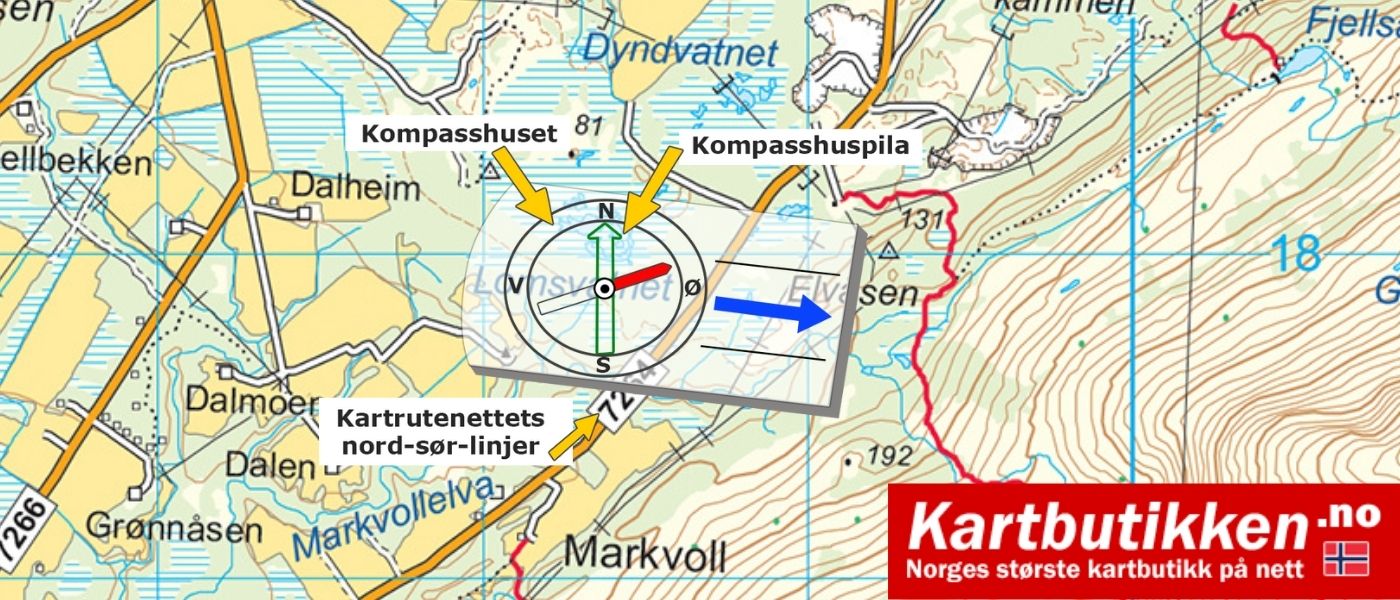
Place the edge of the compass along the straight line from your current location to your destination. Ensure that the direction-of-travel arrow (not the compass needle) points in the same direction: from where you are to where you are going.

Step 2
Rotate the compass housing until the lines within the compass housing are parallel with the map’s north-south grid lines. The compass housing’s ‘N’ mark should point north on the map (this will practically mean on the map). Once this is done, the compass is oriented relative to the map.
Step 3
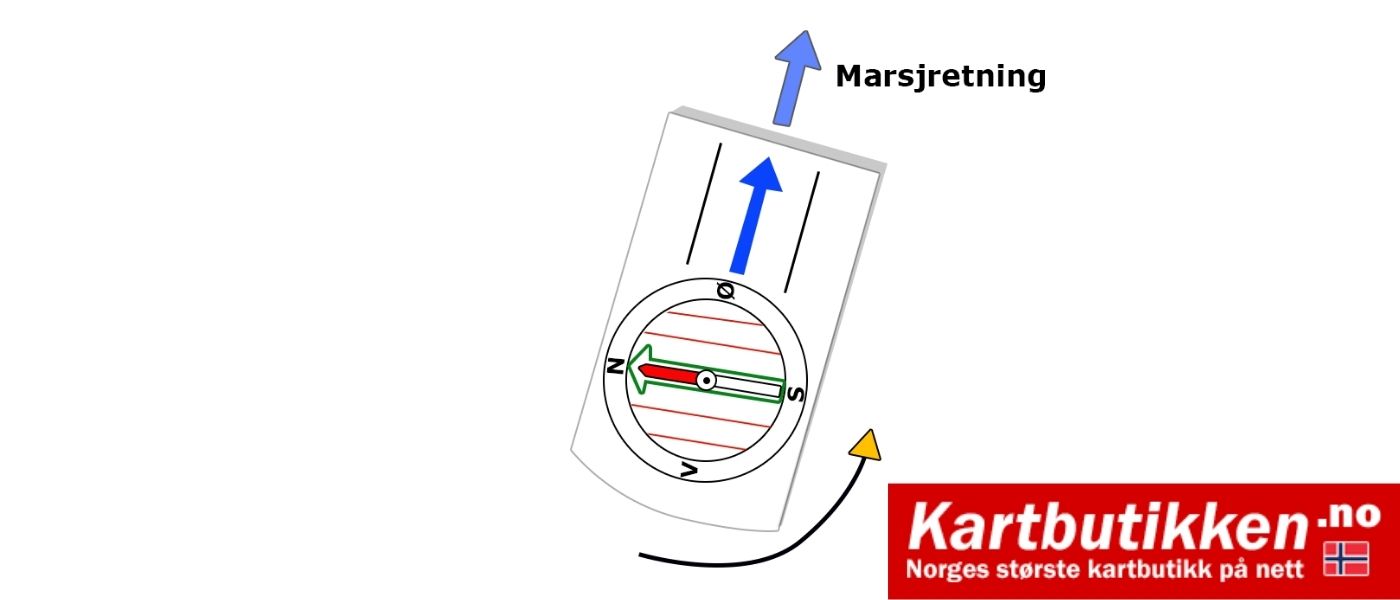
Remove the compass from the map. Correct for declination if necessary (see explanation below). Then, hold the compass flat in your hand. The red compass needle will swing freely and align itself with north. Rotate the compass until the compass housing arrow (the ‘N’ mark)
aligns with the red compass needle. You have now oriented the compass relative to the terrain. The compass’s direction-of-travel arrow (marching direction arrow) will then show you the direction you need to walk.
How to Follow a Compass Bearing
Divide your route into intervals between reliable map features. Use easily identifiable elements such as lakes, road intersections, buildings, or stream crossings as intermediate points.
Once you have set your compass bearing, aim for a point in the terrain that the direction-of-travel arrow (marching direction arrow) points towards. In a forest, it may be wise to find a tree a few hundred meters ahead of you. In the mountains, it may be wise to find a rock outcrop a kilometer ahead of you. When you reach this point, take out your compass again and aim for a new point. Continue this until you reach a secure intermediate point, and only then do you set a new compass bearing.
Remember that metal objects and power lines can affect the magnetic compass needle. Even common items like your watch or knife can cause an incorrect bearing if they come too close to the compass.
What is Declination?
If you need to take a very precise compass bearing, you must account for the declination (in degrees), which arises because the map’s north-south grid lines do not point to magnetic north.
The declination is stated on the map and varies depending on your location in Norway. If you want an accurate compass bearing, you must rotate the compass housing by the number of degrees of the local declination. Turn it clockwise if the declination is easterly, and counter-clockwise if the declination is westerly.

Step 4
Rotate the compass housing by the number of degrees of the local declination. Clockwise if the declination is easterly, and counter-clockwise if the declination is westerly. Then, rotate the entire compass so that the compass housing arrow (the ‘N’ mark) aligns with the red compass needle.
Video explaining the use of map and compass
In this video, Tom Stiansen from ’71 Degrees North’ teaches you how to use a compass with a map.