


Kart.no guide
What size sleeping bag do you need?
The most important thing is that your sleeping bag is not too short or too tight. A little extra length is usually far less of a problem than a bag that puts pressure on your feet, shoulders or head. If you are right on the boundary between two sizes, choosing the larger one will therefore often be the better option. Here we explain why a sleeping bag needs to be longer than your body, how much room you actually need, and how width and fit affect both sleeping comfort and insulation.
Your feet, shoulders or head may press against the insulation and reduce comfort, loft and insulating performance.
Your body should be able to lie naturally, stretch out your feet and move without compressing the insulation.
A little extra length is usually easy to manage. A sleeping bag that is too short cannot be made larger.
The most important thing: your sleeping bag must not be too short
When choosing a sleeping bag size, it is easy to focus on finding a perfectly precise fit. That is useful when possible, but in practice the most important thing is that the sleeping bag is not too short or too tight.
If your toes press firmly against the footbox, or your body presses against the insulation around your shoulders, head or sides, the insulation layer may become compressed. This reduces some of its loft – the volume that traps warm air around your body – and can reduce its insulating performance.
A sleeping bag should therefore provide enough room for your body to lie naturally and move without compressing the insulation. At the same time, it does not need to fit like a tailored garment to work well.
It is better to have a few extra centimetres of space than to spend the night pressing against the footbox. If you are right at the upper limit of a size, the next size up will often be the safer choice.
Compare summer, three-season, winter and expedition sleeping bags, temperatures and sizes – and find the model that suits your trips.
Size is only one part of the decision. Our guide also explains temperature ratings, down, wool and synthetic insulation, seasons, weight, packed size and what to consider when buying a sleeping bag.
Choose by body height – not just the length of the sleeping bag
A common mistake is to compare your own height directly with the total length of the sleeping bag. A person who is 185 cm tall does not need a sleeping bag that is only 185 cm long. The sleeping bag needs to be noticeably longer than the body.
Start by looking at the manufacturer’s stated recommended body height. This is normally a much better measurement to use than the external length of the sleeping bag.
A sleeping bag may be 200 cm long but still be designed for people with a body height of up to approximately 175 cm. The manufacturer’s recommended body height is the figure you should primarily use.
Why does a sleeping bag need to be longer than your body?
Your body height is measured while standing upright with your feet flat on the floor. That is not how you lie when you sleep. When your body is stretched out, your feet naturally point further forward, increasing the effective distance from your head to your toes compared with your standing height.
The footbox also needs enough room for your toes and feet to rest naturally without pressing against the insulation. There should also be a few centimetres of clearance around your head so that your head and the hood do not press against the top of the sleeping bag.
Sleeping bag manufacturers therefore add extra length beyond the stated body height. Many sleeping bags have around 15 cm of additional length, while Grüezi Bag uses approximately 25–30 cm of additional length in several of its mummy sleeping bags. This provides more room for both feet and head and reduces the risk of your body compressing the insulation.
A person who is 185 cm tall needs additional length for extended feet, the footbox, a natural sleeping position and clearance around the head. A sleeping bag around 215 cm long can therefore be entirely appropriate for a person who is 185 cm tall.
Is it a problem if the sleeping bag is slightly too long?
Usually not. Technically, a larger sleeping bag has slightly more internal volume, normally weighs a little more and takes up slightly more room in your pack. Your body also has a somewhat larger volume of air to warm.
However, this is usually a much smaller issue than choosing a sleeping bag that is too short. A little extra length rarely has a dramatic effect on performance, while a sleeping bag that is too short can cause your feet or head to compress the insulation.
Extra room in the footbox? Put it to use
If your sleeping bag has a few centimetres more length than you actually need, you can fill some of the empty space with a dry jacket, spare clothing or other dry equipment. This reduces the volume of air your body needs to warm.
There is also a pleasant bonus the next morning: clothes that have been inside your sleeping bag overnight will be warm when you put them on.
Dry shoes can also be placed at the bottom of the sleeping bag if desired, preferably inside a bag that keeps dirt and any residual moisture away from the sleeping bag.
The technical optimum and the practical choice are not always the same
On paper, the optimal sleeping bag is the smallest size that gives you enough room without compressing the insulation. In real life, sleeping bags are often used in several different ways.
Perhaps you are buying one good sleeping bag that both you and your partner will use. Perhaps a son or daughter will borrow it. Or perhaps the sleeping bag is for a teenager who still has several centimetres left to grow.
In these situations, a little extra length is a perfectly sensible compromise. The sleeping bag can still work very well while becoming more flexible and remaining useful for longer.
One sleeping bag for several people?
If the same sleeping bag will be used by people of different heights, it makes sense to size it for the tallest user. The shorter person will normally be able to use a slightly longer bag without difficulty.
Sleeping bag for a teenager?
A little room for growth is normally fine. It is rarely necessary to buy a bag that fits perfectly in the first year of use if the teenager will soon grow out of it.
When is a sleeping bag actually too large?
There is, of course, a limit. A very small person in a very large adult sleeping bag will have a lot of unnecessary volume around the body, and the bag may feel both cumbersome and less efficient.
But there is a big difference between a sleeping bag that fits precisely and one with a few extra centimetres of length. There is rarely any reason to worry about choosing a slightly roomier bag if you are close to a size boundary or want greater flexibility.
Length is only one part of the fit
Two sleeping bags with the same length can feel very different. Also consider shoulder width, foot width and the overall shape of the sleeping bag.
Enough room around your body makes it easier to move and turn inside the sleeping bag, rather than having the entire sleeping bag move with you when you change sleeping position.
Width also affects insulation. If the sleeping bag is so tight that your shoulders, hips, knees or feet press against the insulation, the loft can be reduced. When insulation is compressed, its ability to trap warm air can also decrease.
You should therefore not compare sleeping bags only by temperature rating, weight and packed size. Also look at the actual dimensions and how much room the construction gives your body. A small difference in weight may, for example, simply mean that one sleeping bag is wider and gives the user more room.
Grüezi Bag
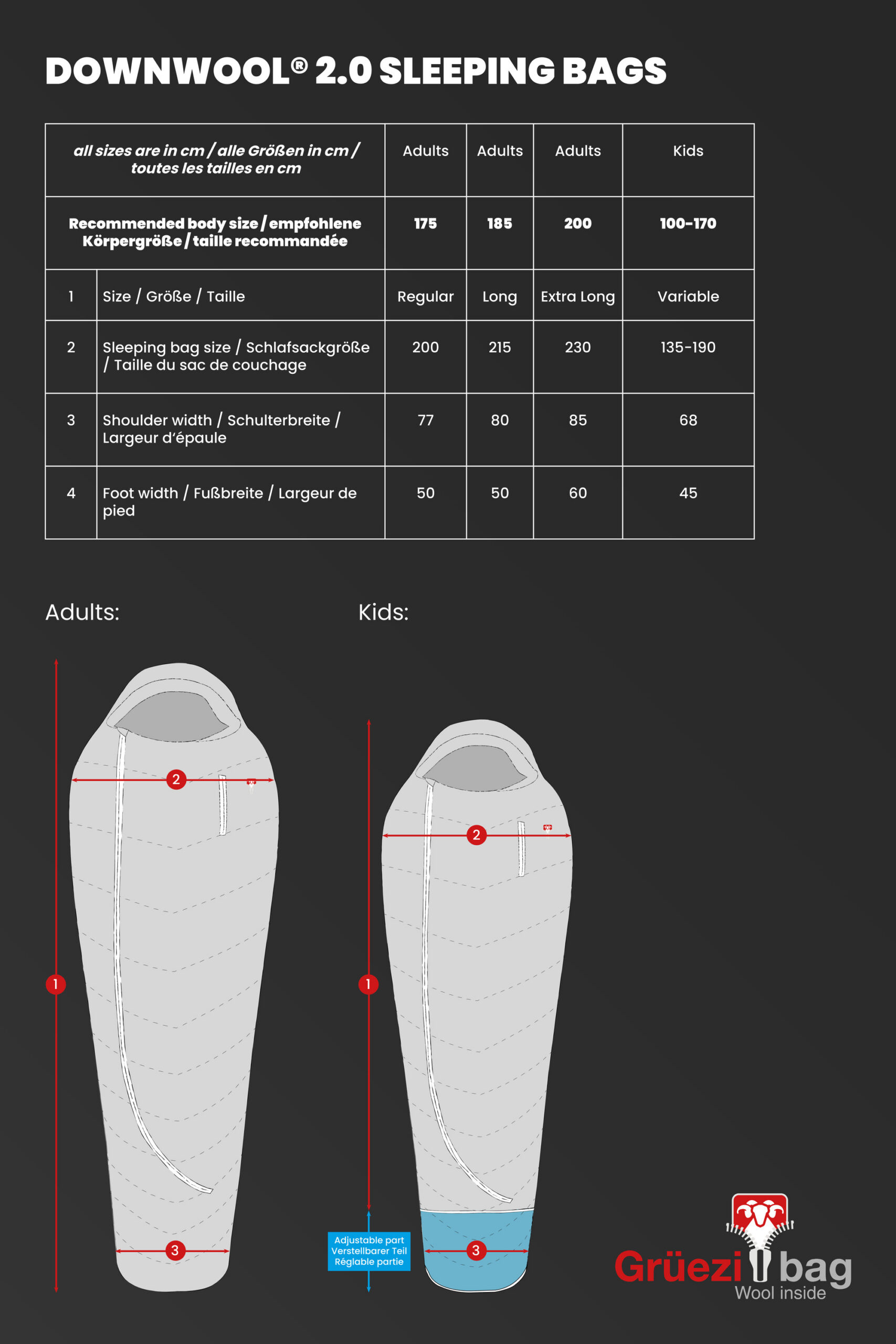
Size guide for Grüezi Bag DownWool® 2.0
The standard DownWool® 2.0 mummy sleeping bags from Grüezi Bag use three main adult sizes: Regular, Long and Extra Long.
Grüezi Bag builds a relatively generous length allowance into its sleeping bags. Regular is 200 cm long and recommended for body heights up to approximately 175 cm. Long is 215 cm long and recommended up to approximately 185 cm, while Extra Long is 230 cm long and recommended up to approximately 200 cm.
This means there is normally around 25–30 cm difference between the recommended maximum body height and the total sleeping bag length. This extra length provides room for a natural foot position, the footbox and clearance around the head.
| Size | Recommended body height | Sleeping bag length | Shoulder width | Foot width |
|---|---|---|---|---|
| Regular | Up to approx. 175 cm | 200 cm | 77 cm | 50 cm |
| Long | Up to approx. 185 cm | 215 cm | 80 cm | 50 cm |
| Extra Long | Up to approx. 200 cm | 230 cm | 85 cm | 60 cm |
What should you choose if you are close to a size boundary?
If your body height is right at the upper end of the manufacturer’s recommendation, we would normally recommend going up one size.
If you are 185 cm tall, for example, Long is technically designed for body heights up to 185 cm. But this puts you right at the upper limit of the size. For most people, Extra Long will provide a more relaxed safety margin and more room to stretch out the feet without pressing against the footbox.
The same applies if you are around 175 cm and deciding between Regular and Long. Regular may still fit, but if you prefer a little more room, move a lot during the night or simply want some extra margin, Long will often be the safer choice.
The smaller sleeping bag may be a few grams lighter and have a slightly smaller packed size. In return, the larger model provides more length and often more room around the body.
If you are clearly within one size, choose it. If you are right on the size boundary, normally choose the next size up. A little extra length is easy to manage. A sleeping bag that is too short cannot be made larger.
Not all Grüezi Bag sleeping bags use the same sizes
Regular, Long and Extra Long apply to a range of DownWool® 2.0 models. Some models have a different construction and therefore use different sizing systems.
DownWool Ice Extreme
Available as 180, 190 Wide and 200 Wide. The three sizes are recommended for body heights up to 180, 190 and 200 cm respectively. The Wide models provide additional width and therefore do not follow the standard Regular/Long/Extra Long table.
Wolle Survival
Available as Survival and Survival XXL. Survival is 215 cm long, 80 cm wide at the shoulders and recommended for body heights up to 185 cm. Survival XXL is 230 cm long, a full 95 cm wide at the shoulders and recommended up to 200 cm.
DownWool Two-in-One Comfort 2.0
This is a spacious rectangular comfort sleeping bag and therefore does not follow the sizing logic of traditional mummy sleeping bags.
Children’s sleeping bags
DownWool KidsTeen and Wolle Kids World Traveller can be adjusted in length and are designed to grow with the child over several years.
What size sleeping bag should children and teenagers use?
For children and teenagers, it often makes sense to allow some room for growth. A sleeping bag that is slightly longer than necessary when first used is normally not a problem.
The important thing is that the sleeping bag is not extremely large relative to the child and that the fit still works well. For teenagers approaching adult height, choosing an adult size that they can grow into can therefore be entirely sensible.
Grüezi Bag also offers adjustable children’s models
Grüezi Bag DownWool KidsTeen and Grüezi Bag Wolle Kids World Traveller can be adjusted for body heights from approximately 100 to 170 cm. An adjustable foot section allows the sleeping bag to be shortened when the child is small and extended as the child grows.
Remember that size alone does not determine how warm you sleep
A well-fitting sleeping bag helps the insulation work as designed, but size is only one part of the overall system. Temperature, wind, humidity, clothing, individual sensitivity to cold and, importantly, insulation from the ground also play a role.
A well-insulated sleeping mat is therefore very important as temperatures fall. Even a warm sleeping bag can feel cold if the mat provides poor insulation from the ground. One example is the Grüezi Bag DownWool Mat Trekking , which has an R-value of 3.9 and integrated down and wool insulation.
Choose with a sensible margin
The technical optimum is a sleeping bag that gives your body enough room without unnecessary volume. If you are right on the size boundary, however, we would normally recommend choosing the next size up. Avoiding pressure from your feet, head or body against the insulation is more important than saving a few centimetres of length. Extra space in the footbox can also be filled with dry clothing or other equipment. To explore the options, see all sleeping bags at Kart.no .